A calm wrist instrument
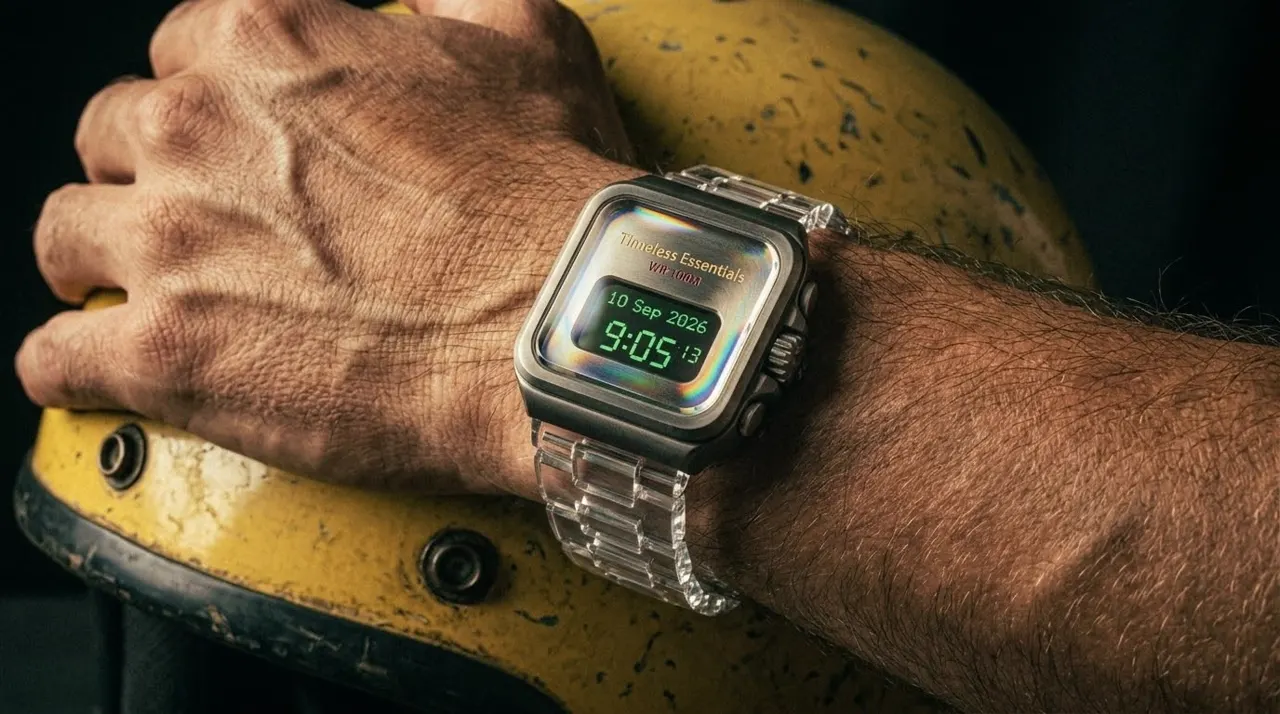
A calm, repairable wrist instrument that lives between the Casio F-91W and the Apple Watch Ultra. Accessible enough for everyday wear, tough enough for the trail. We are designing it in the open: the spec, the emulator, and the journal all live in public while the object itself is still taking shape.

Attention is the resource
A watch should give time back, not take it. Most smartwatches compete for attention. Ours is built to end the interaction in one glance, so the rest of the day belongs to the wearer. Three rules carry that thesis into hardware and software.
Calm by default: a monochrome OLED shows the time, always, with legibility, battery life, and one-glance information ahead of feature count. Repairable by design: a CNC aluminum case, a back cover on four Torx screws with a gasket seal, and a quick-release strap, because a tool you cannot open is a tool you do not own. One glance is enough: two pill buttons and a rotary crown run the whole watch, every mode answers a single question, and a feature that demands more attention than that does not ship.
Formerly Trek Watch. The name changed as the thesis sharpened: this was never about the trail alone, it is about a quiet instrument for every day that also survives the trail.
Decided in the open, with the gaps listed
The markdown spec is the single source of truth and the site renders it live, so the page cannot drift from the source. Case target is 42 by 36 by 9 millimetres under a 30 gram ceiling, with 10 ATM water resistance from minus 20 to 50 degrees. Display is a one inch class monochrome OLED on a dark ground, a move from e-paper in September 2026, with a matte anti-reflective stack and a peak brightness burst on wrist raise. Compute is a Nordic nRF52840. Input is two pill buttons plus a rotary crown, all contactless through Hall-effect and magnetic sensing, so no shaft pierces the seal. Haptics come from an LRA driver benchmarked against the best in the business, with a piezo buzzer for chimes. Timing is true 1/100 second from hardware timers. Power target is 30 days including notification serving, now hinging on the always-on dim level of the emissive panel.
What is still open is numbered and linkable in the full spec: panel selection, brightness strategy, burn-in mitigation, piezo placement, the charging puck magnet check, the full gesture map, and the deliberate call on whether games ever ship against the calm thesis.
Emulate first, then cut metal
The watch OS runs in the browser before any circuit board exists. A single-file emulator on vanilla JavaScript and canvas mirrors the microcontroller loop, so every interaction gets tested where iteration costs nothing: crown rotate, crown press, two pill buttons, stopwatch, alarms, heart rate on demand. When the prototype stops surprising us, the question becomes a production run, and the journal will show exactly how that decision went.